
Almost every organization I meet already pays for AI licenses: ChatGPT, Copilot, Claude or Gemini. And in almost all of them, the way people use these tools is very basic: questions and answers, writing emails, fixing documents, translation, and that's more or less it.
So why aren't these tools built into the real workflows, saving the organization time and money? The answer is simple: bringing AI into an organization is a process, not a purchase. Buying licenses is the easy part. What typically happens next is that a few enthusiasts use the tools every day, a large group tried them once or twice and went back to the old way of working, and managers are not sure what employees are allowed to paste into a chatbot. When the renewal comes up, nobody can say what the organization got for its money.
Generative AI is not another piece of software you install. It changes how people write, analyze, plan and decide, which makes it a cultural and organizational change as much as a technical one. The organizations that get real value from AI treat it the way they would treat any other change program: with rules, priorities, experiments, measurement and a plan to scale what works.
Let's see what this process looks like, stage by stage.
The Five Stages
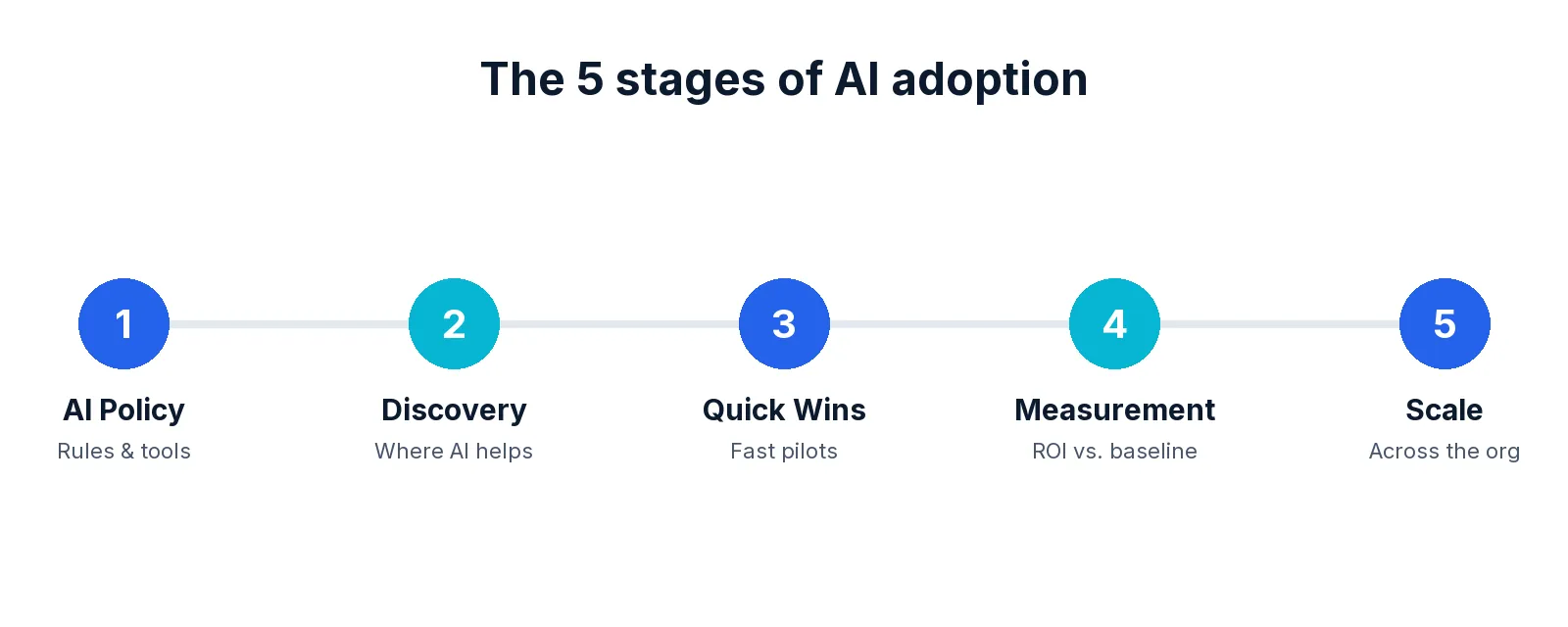
This is the structure of the AI Transformation Program I run with organizations. Each stage produces something concrete that the next stage builds on:
| Stage | What happens | What you get |
|---|---|---|
| 1. AI Policy | Define the rules for responsible use of AI tools, in line with your information security standards, and choose the tools each department will use. | A clear policy and an approved list of tools |
| 2. Discovery | Map bottlenecks, repetitive tasks and processes where AI can create business value quickly. | A prioritized list of use cases |
| 3. Quick Wins | Run practical pilots on the top use cases, using general AI tools, custom bots, agents, automations or software development. | Working solutions in real workflows |
| 4. Measurement | Measure the ROI and business results of each pilot against how the work was done before. | Numbers that show what worked, and what didn't |
| 5. Scale | Expand successful use cases to more teams and tasks, with ongoing support and new tools as they appear. | AI as part of everyday work across the organization |
Along the way, teams get hands-on AI workshops on the tools that were chosen, and a group of "AI champions" from each department leads the change from the inside. They know the AI tools best, and they also know the organization's processes well, which makes them the group best suited to lead the change.
Most organizations skip the first stage. When I ask employees and managers whether they know what they are and aren't allowed to do with AI tools, the answer is usually no. There is also a tendency to restrict uploading company data to AI tools for information security reasons, but that seriously limits the ability to build AI into the organization's actual work. The Enterprise versions of the AI chatbots offer a high level of data security, and most organizations (except, for example, defense or financial organizations) can use them without restrictions on company data. That's why it's important to define the organization's policy up front, and to choose the right tools together with the legal and IT departments.
Common Mistakes
- Starting with tools instead of problems: choosing a platform before anyone has mapped which tasks it should improve.
- No policy, or a policy that only says "don't": employees either avoid AI entirely or use personal accounts without any oversight.
- Workshops for employees without a follow-up plan: people need practice on their own tasks, not only a demo.
- Pilots without a baseline: if you didn't measure how long a task took before, you can't prove the improvement after.
How Long Does It Take, and What Does It Cost?
These are the two questions every manager asks first, and the answer is that both depend on scope. The main factors are the number of departments and participants, how many workshops and one-on-one training sessions the teams need, and how many pilots you decide to implement, and how complex they are.
The timeline follows the stages: first the policy and discovery, then pilots whose results are measured, and finally a gradual scale-up, with ongoing support as new use cases are added.
As a rough guide, discovery takes about 3 hours per team (a group of people with similar tasks), and the organization then sets the priorities itself. Implementing each pilot can take anywhere from two hours to two or three days, so in a mid-sized organization the whole process can be completed within just a few weeks.
Where to Start Tomorrow Morning
You don't need a big program to take the first step. If you're a manager who wants to get moving this week, here is a simple way to begin:
- Write a one-page AI policy: which tools are approved, and what information must never be pasted into them.
- Pick one team that is already curious about AI, rather than trying to cover the whole organization at once.
- Choose three repetitive tasks in that team, and write down how long they take today.
- Give the team hands-on training on those exact tasks, and measure again after a month.
Summary
AI adoption succeeds when it is treated as a process with clear stages, not as a license you buy and hope for the best. Start with rules, focus on real problems, prove the value with numbers, and only then scale. If you'd like to talk about what this could look like in your organization, send me a WhatsApp message or read more about the AI Transformation Program.