

This week I gave a talk at Haifa BeerTech on using AI tools efficiently, so you don't get blocked for a few hours every time on your paid plan. You know the feeling: you are deep in a task, and suddenly the chat tells you to come back later. The good news is that most of those blocks can be avoided. For anyone who missed the talk, here are the main lessons...
Tokens, Briefly
A token is the unit an AI model reads and writes: a short word, part of a longer word, a punctuation mark or a few digits. As a rule of thumb, 1,000 tokens are about 750 English words. Everything you send to the model is counted in tokens (your prompts, the documents and images you upload, and the conversation so far), and so is everything the model writes back. API customers pay per token. Subscribers on the $20-a-month plans pay a fixed price, but their usage is still measured in tokens, and when they run out, the chat stops.
In Claude, for example, usage limits reset on a rolling five-hour window, and paid plans add weekly limits on top. How much you can do in that window depends on how long your conversations are, which model you choose and which features you use. In other words: how you spend your tokens.
One way out is to pay more. Both ChatGPT and Claude sell higher plans that give you several times the usage of the basic $20 plan:
| Price per month | ChatGPT | Claude |
|---|---|---|
| $20 | Plus (1×) | Pro (1×) |
| $100 | Pro 100 (5×) | Max 5x (5×) |
| $200 | Pro 200 (10×) | Max 20x (20×) |
| $500 | Pro 500 (25×) | No plan |
But before you pay five or twenty-five times more, it's worth getting more out of the plan you already have. Three habits make the biggest difference.
Long Conversations
The biggest token eater is the length of the conversation. The model itself has no memory, so the chat app sends it the entire conversation with every new message: everything you wrote and everything the model answered since the beginning. Your tenth question carries the nine questions and nine answers before it. Each turn grows only a little, but the total grows fast.
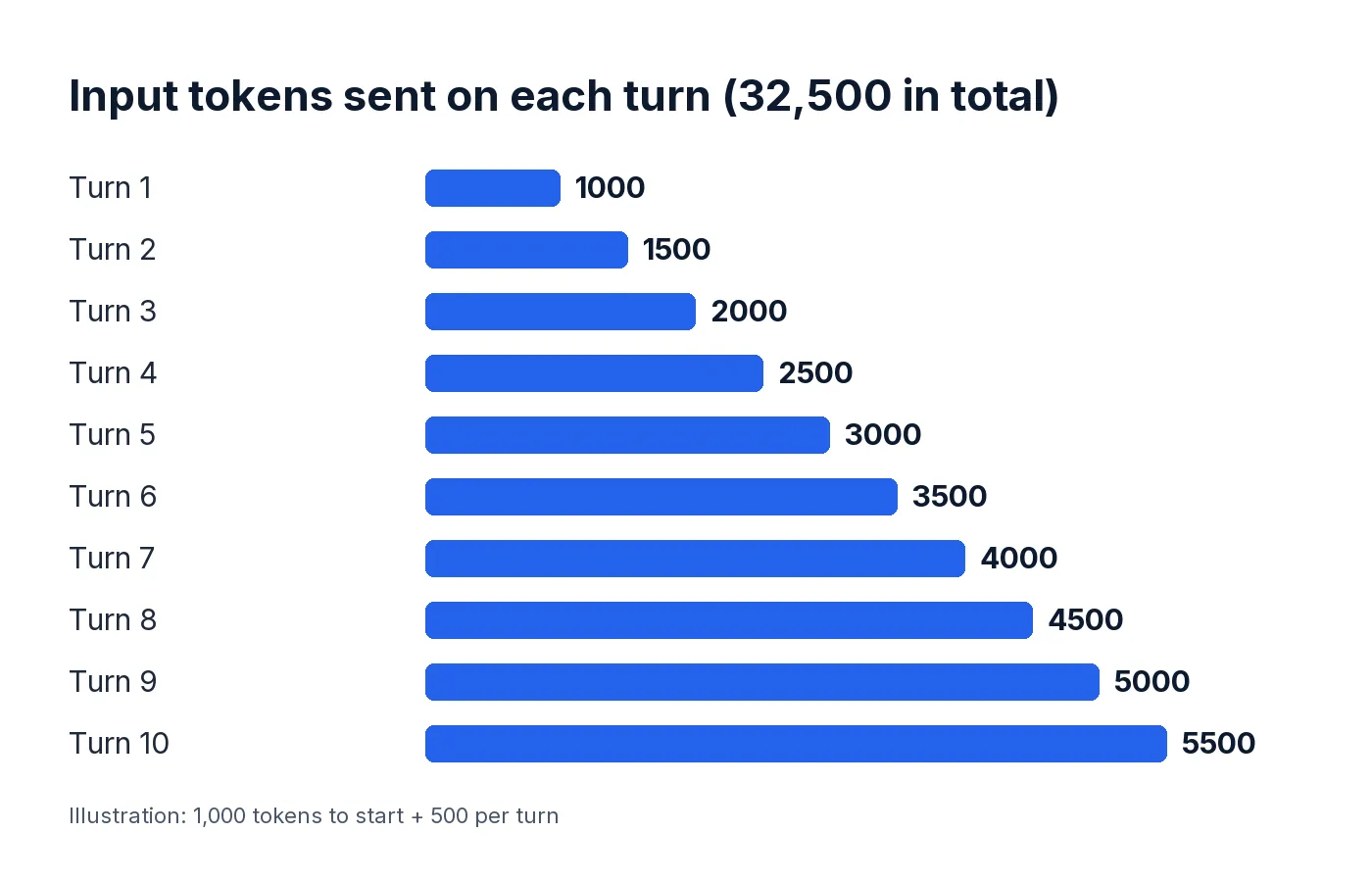
That's why it pays to open a new conversation from time to time, even when you keep working on the same subject. Good moments are when the topic changes, when the thread is full of trial and error, when large documents or tool results have piled up, or when the answers start drifting and repeating themselves. You don't need to start from zero: ask the chat to summarize the conversation, and paste the summary into the new one. Here's a handoff prompt I use:
Prepare a handoff for a new conversation. Include the objective, confirmed facts, decisions already made, constraints and open questions. Separate facts from assumptions, preserve critical figures exactly, and use no more than 400 words.
One caution: a summary is not a substitute for the source. For anything legal or financial, bring the original document into the new conversation too.
The Right Model
Heavy, smart models cost about 100 times more than fast, simple ones. You don't need a physics professor to write a grocery list. Here is what the models cost on the API, which is also a good indication of how quickly each one uses up a subscription's limits:
| Model | Input | Output | Good for |
|---|---|---|---|
| Claude Fable 5.1 | $10 | $50 | The hardest, longest tasks |
| Claude Opus 5.5 | $4 | $20 | Hard judgment calls |
| Claude Sonnet 5.5 | $2 | $10 | Most daily work |
| Claude Haiku 5.5 | $0.10 | $0.50 | Formatting, translation, routine drafts |
| GPT-6 Astra | $10 | $50 | The hardest, longest tasks |
| GPT-6.1 Sol | $2 | $10 | Most daily work including hard judgement calls |
| GPT-6 Luna | $0.10 | $0.50 | Formatting, translation, routine drafts |
Sources: claude.com/pricing and OpenAI API pricing.
The model is only one dial. You can also set the effort level, which is how many tokens the model will invest in thinking about your task before it answers. A higher effort level means more thinking tokens on every single answer. Matching both the model and the effort level to the task in front of you will save a lot of tokens, and let you work continuously even on a basic $20 plan.
Get It Right the First Time
Look at the table again: on every model, output tokens cost five times as much as input tokens. Your instructions are cheap. The model's answers are expensive. So it is worth investing in a detailed prompt that defines the length of the answer, the number of options, the format and the style. Then the first answer is close to what you want, and you don't spend more tokens on rounds of corrections.
Compare "Write some subject lines for our newsletter" (which will probably return a dozen options, an explanation of each one and an offer to write more) with "Write three subject lines under 60 characters for our October newsletter to existing clients. A good subject line names one concrete benefit." The most important part is that last sentence. When you tell the model what good looks like, it builds the answer around your criteria from the start.
Don't take this to the other extreme, though. A prompt trimmed so much that the model misunderstands it, or that is missing a key constraint, doesn't save anything: you pay again in corrections, in redoing the work and in your own time. The right measure is not the number of tokens, but the cost of an answer you can actually use.
Let AI Build the Tool
One more idea from the talk: if a task doesn't need judgment or language understanding (the same input always produces the same output), don't ask the model to do it again every week. Ask it once to build a small tool that does it, for example a Claude artifact, a ChatGPT Site, or an app built with Lovable or Base44. Reformatting a weekly export, calculating a payment schedule or checking that all required fields are filled are jobs for software, and once the tool exists, every run costs zero tokens. You can see some of the web apps I've built this way for Gamdala's customers on our AI use cases page.
The best workflows combine the two: AI reads the document once and extracts what matters, software does all the repetitive calculations, and a person approves anything with legal or financial weight. Building these tools is exactly what we practice in our Vibe Coding workshop, with no programming background required.
Summary
Before your next long session, ask yourself a few quick questions:
- Should I start a new conversation?
- Am I using the right model and effort level for this task?
- Have I said how long the answer should be, and what a good answer looks like?
- Should software be doing part of this?
Get these four right and you will hit the limit much less often, even on the basic plan. If you'd like this talk for your own team, take a look at my presentations for organizations.